Skip to content
T-ERP Technologies
Operations & Freight

On-Board Weighing for Mining Trucks: Payload Guide

How on-board weighing controls mining truck payload, why mine roads and public roads follow different rules, and how to apply the 10/10/20 policy.

By T-ERP Compliance Team13 min read
On-Board Weighing for Mining Trucks: Payload Guide
In this article
  1. Which Rules Apply to Payload on a Mine Road?
  2. When Does a Mine Road Become a Public Road?
  3. How Do On-Board Weighing Systems Work on Mining Trucks?
  4. What Is the 10/10/20 Payload Policy?
  5. How Does Payload Affect Tyres, Fuel and Components?
  6. How Can You Move More Tonnes per Shift Without Overloading?
  7. Which Payload Records Should a Mine or Contractor Keep?
  8. How Do You Turn Payload Data Into Decisions?
  9. Conclusion
  10. Sources
  11. Frequently Asked Questions

Published: 30 October 2026

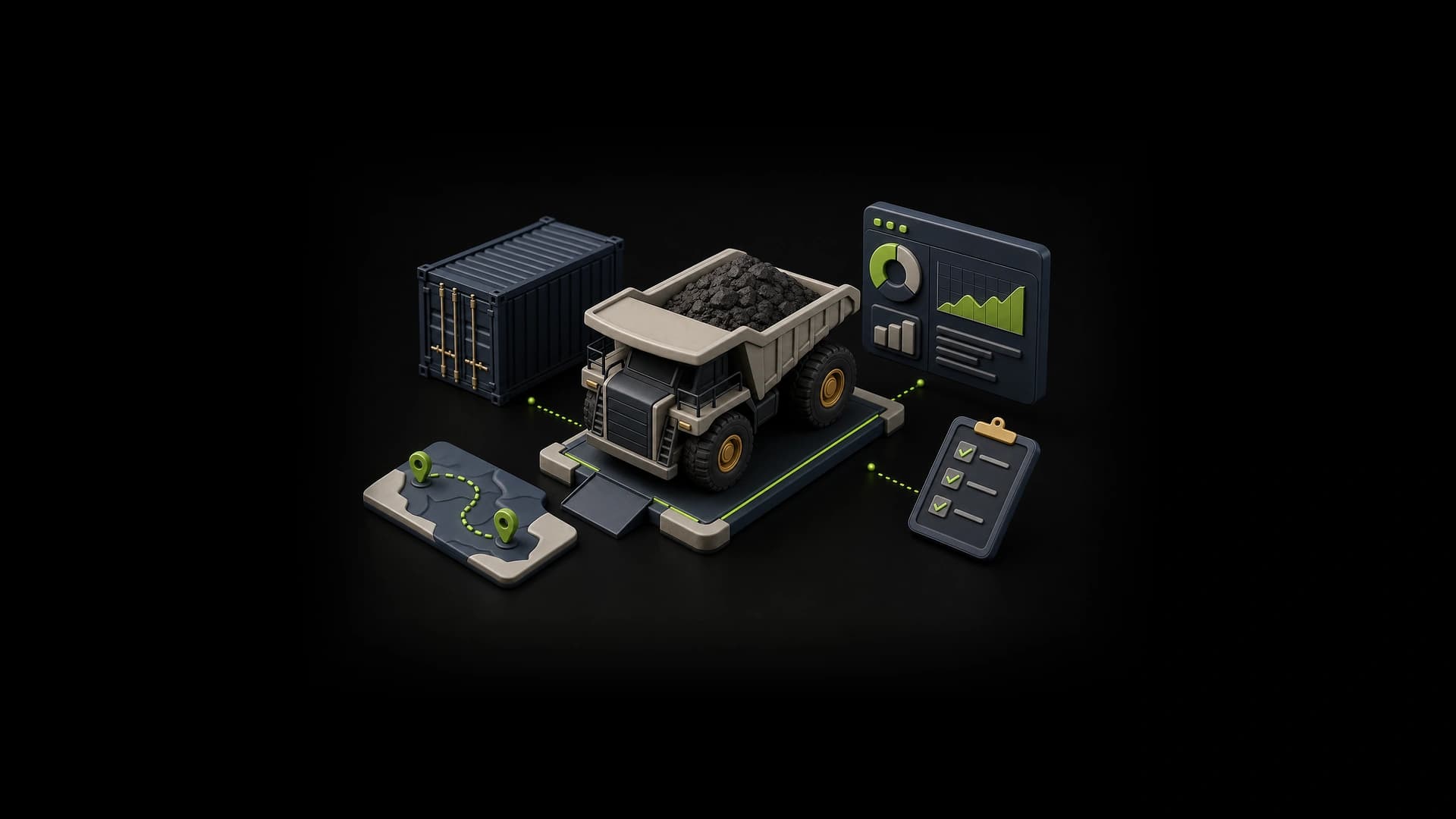
On-board weighing for mining trucks gives every load a number: the payload the truck is carrying as it leaves the loading face. On South African mines, that number decides how many tonnes move per shift, how long tyres and drivetrains last and how safe the truck is to steer and brake on a ramp. It also matters for a reason many operators overlook: the rules that govern payload change completely when a truck leaves the mine road and turns onto a public road.

This guide explains how payload is managed inside the mine boundary, how on-board weighing works, how to use the data, and where the National Road Traffic Act takes over. For the wider legal picture on mine transport, see our mining transport compliance guide.

Which Rules Apply to Payload on a Mine Road?

This is the distinction that drives everything else. Inside a mine, articulated dump trucks (ADTs) and rigid haul trucks are trackless mobile machines (TMMs) under the Mine Health and Safety Act 29 of 1996 (MHSA). The employer must assess the risks of each machine and its use, and Chapter 8 of the MHSA regulations (regulation 8.10) requires measures against risks such as uncontrolled running, overturning and collisions. Overloading feeds directly into those risks, because an overloaded truck takes longer to stop and is harder to steer, particularly downhill.

What the mine road does not have is a roadside fines schedule. The NRTA mass limits, weighbridge prosecutions and overloading fines are written for public roads. On the mine, payload control comes from the mine's own risk assessment, its TMM code of practice, the OEM's payload policy and the operating procedures that flow from them. A breach is a safety and management failure that can lead to an inspector's instruction or a section 54 stoppage, not a traffic fine.

| Question | Mine haul road | Public road |
|----------|----------------|-------------|
| Main law | MHSA and its regulations | National Road Traffic Act 93 of 1996 and regulations |
| Payload limit set by | OEM rating, payload policy and the mine's risk assessment | Regulated axle, vehicle and combination mass limits |
| Who enforces | The mine, and DMPR inspectors | Traffic officers and weighbridges |
| Consequence of overloading | Safety risk, component damage, possible inspector action | Fines, offloading at the weighbridge, prosecution |
| Typical vehicles | ADTs, rigid haul trucks | Side tippers, interlinks, tri-axle tippers |

Our post on section 54 stoppages and TMM compliance covers how inspectors act when machine safety slips.
Take Action Map every route your trucks use and mark which sections are mine roads and which could be public roads. That map tells you which payload rules apply on each trip.

When Does a Mine Road Become a Public Road?

Ownership alone does not decide it. The NRTA defines a public road as any road, street or other place commonly used by the public, or any section of it, or to which the public has a right of access. Commentary on the Act, including Arrive Alive's summary of the case law, notes that a road inside a mine's property can still be treated as public if the public uses it and the mine does nothing to stop that. A "private road" sign on its own has not been enough.

In practice, this matters in three places:

  • Access roads between the plant and the nearest provincial road, especially where locals, taxis or farm traffic use them.
  • Product haulage from the mine stockpile to a siding, port or customer, which is almost always on public roads.
  • Contractor routes that cross a district road between two parts of a mining right.

Once a truck is on a public road, the full NRTA mass regime applies. Regulation 237 sets the permissible maximum combination mass as the lowest of several limits, including axle and axle-unit limits, the bridge formula and the manufacturer's ratings, with an overall ceiling of 56,000 kg. An ADT rated for 40 tonnes is not designed or licensed for that regime at all. Road-going product trucks need their own load control, covered in our overloading management post and the overloading management guide.

How Do On-Board Weighing Systems Work on Mining Trucks?

An on-board weighing system estimates payload from sensors already fitted to, or added to, the truck. The main approaches are:

  • Suspension pressure sensing. Many rigid haul trucks use hydro-pneumatic suspension struts. Sensors read strut pressures and the system converts them to payload. Most large OEMs offer this as a factory payload monitor.
  • Hydraulic or tipping cylinder sensing. Some systems read pressure in the hoist or body cylinders, often at a set point in the cycle.
  • Load cells or strain gauges. Sensors mounted between body and chassis, or on the frame, measure load directly. Common as aftermarket kits on ADTs and road trucks.
  • Loader-side scales. Payload systems on excavators and wheel loaders weigh each bucket, so the loader operator knows the running total before the last pass.

Accuracy depends on the system, calibration, the slope the truck stands on and whether it is weighed moving or stationary. Ask suppliers for their stated accuracy under your site conditions, not a test-bench figure.

When choosing a system, look for:

  • A display or lights visible to both the loader operator and the truck operator
  • Automatic logging of every load with time, truck, loader and operator
  • Data export or an interface your fleet and production systems can read
  • Configurable overload and underload thresholds
  • A clear calibration procedure and calibration records
  • Protection against tampering

On-board weighing is for production control and safety. If material is bought or sold by mass, the trade weight should come from a weighing instrument that complies with the Legal Metrology Act 9 of 2014, which the National Regulator for Compulsory Specifications administers. Most mines use a verified weighbridge for that.

What Is the 10/10/20 Payload Policy?

Caterpillar publishes a widely used rule for mining trucks, the 10/10/20 policy. In Caterpillar's words, no more than 10% of loads should exceed 110% of target payload, and no load should ever exceed 120%. The mean of all payloads should not exceed the target payload. Caterpillar links overloading to structural damage, higher fuel burn, shorter component life and poorer tyre life, and the 120% limit is tied to safe steering and braking. Other OEMs set their own policies, so check the one for your machine.

The policy is useful because it measures the spread of payloads, not just the average. A fleet averaging exactly 100% can still break it if loads swing widely. Research presented at the APCOM symposium found that the number of loader passes affects payload spread: more passes per truck reduce variation and make the policy easier to meet.

How to apply it:

  1. Set a target payload per truck model from the OEM rating, adjusted for body type and any site restrictions.
  2. Log every load with on-board weighing or loader scales.
  3. Report weekly: mean payload against target, percentage of loads over 110%, and any load over 120%.
  4. Treat any load over 120% as an incident to investigate, and decide in your procedure whether it is tipped back before hauling.
  5. Track underloads too, because they cost productivity.
Take Action Pull one week of payload data and test it against the 10/10/20 rule for each truck and each loader. If you have no data yet, weigh a sample of loads on a weighbridge to see how wide your spread really is.

How Does Payload Affect Tyres, Fuel and Components?

Overloading increases the load on every tyre, axle, strut and frame member. For tyres, the main mechanism is heat. More load means more flex in the sidewall, more heat build-up and faster breakdown of the casing. Tyre makers rate tyres by load and speed, often expressed as tonne-kilometres per hour, so a heavier truck that keeps the same speed may push tyres beyond their rating on long hauls.

We have not found a published, verifiable figure for how much faster tyres wear at a given overload percentage, and the effect varies with road, speed and temperature. Rather than rely on rules of thumb, build your own evidence: record payload, tyre removal reasons and hours per tyre position, then compare trucks and routes. Our ADT tyre cost reduction post explains how to track tyre cost per hour.

Underloading is not harmless either. If trucks leave the face light, you need more cycles for the same tonnes, and more cycles mean more fuel, more tyre kilometres and more operator hours per tonne. The goal is a tight spread around the target, not the heaviest possible load.

Haul road condition affects both sides. Rough roads cause spillage, slow trucks and add stress to tyres and frames. See our haul road management guide for a maintenance schedule.

How Can You Move More Tonnes per Shift Without Overloading?

Most gains come from consistency and cycle time, not heavier loads.

| Lever | What to do | What to measure |
|-------|-----------|-----------------|
| Reduce payload spread | Use loader scales and a pass-count standard; coach loader operators | Payload standard deviation per loader |
| Match loader to truck | Check that a whole number of full passes reaches target | Passes per load, last-pass size |
| Cut queue time | Balance trucks to loaders in dispatch | Queue minutes per cycle |
| Improve haul roads | Grade, water and drain to a schedule | Cycle time and speed per road section |
| Fix carry-back | Clean bodies where sticky material builds up | Tare drift on the weighing system |
| Plan the shift | Set truck numbers and targets per face before the shift | Tonnes per operating hour |

Loader matching deserves attention. If the bucket does not divide neatly into the truck's target, operators either leave the truck short or add a part pass that pushes it over. Adjusting bucket fill, the pass count or the target removes that guesswork. Our load planning post covers the same planning discipline for road-going side tippers.

Which Payload Records Should a Mine or Contractor Keep?

The MHSA does not prescribe a single payload register, but your risk assessment, code of practice and procedures will usually require evidence that loading is controlled. Useful records include:

  • Load log: date, time, truck, loader, operators, material, payload and destination
  • Exception log: overloads and underloads with the action taken
  • Calibration records: date, method, result and who did it, for each weighing system
  • Training records: loader and truck operators trained on payload targets and procedures
  • Weekly payload report: 10/10/20 results by truck and by loader
  • Weighbridge reconciliations: on-board totals compared with the weighbridge for product leaving site

For contractors, load-level records also make tonnage claims easier to invoice and harder to dispute.

Take Action Write a one-page payload procedure: the target per truck model, the overload limit, what happens to a load over the limit, who reviews the weekly report and how often weighing systems are calibrated. Train every loader and truck operator on it.

Quick estimate

What are paper trip sheets costing your fleet?

30drivers
5200
2staff
110
R 15,000
R8,000R30,000

How Do You Turn Payload Data Into Decisions?

Weighing data is only useful when someone acts on it. A practical review rhythm looks like this:

  • During the shift: dispatch watches loads that breach the thresholds and calls the loader.
  • End of shift: the supervisor reviews tonnes per truck, exceptions and queue time.
  • Weekly: operations reviews 10/10/20 results, loader performance and calibration status.
  • Monthly: management compares payload trends with fuel, tyre and maintenance cost per tonne.

This is where separate systems get in the way. Payload sits in the OEM portal, tyres in a spreadsheet and maintenance in a workshop system, so nobody sees the link. T-ERP brings trips, loads, fuel, tyres and work orders together per asset, so you can import or capture payload records and compare them with cost per tonne. See how this fits mining operations and our fleet management solution.

Conclusion

On-board weighing for mining trucks turns payload from a guess into a managed number. Inside the mine, payload limits come from the OEM's rating and policy and the mine's MHSA risk assessment, not from a traffic fines schedule. Outside the mine, or on any road the public commonly uses, the NRTA mass limits apply and the vehicles and controls need to suit that regime.

Set a target per truck, measure every load, test the spread against a policy such as 10/10/20 and act on the exceptions. Gains in tonnes per shift come from tighter loading, matched loaders, good roads and short queues.

Take Action Start with one loader and its trucks for a month. Measure payload spread, passes per load and queue time, fix the biggest gap and compare the tonnes per operating hour. If you would like help setting up the records, schedule a consultation.

Sources


The information in this article is for general guidance only. Regulations and requirements may change - always verify current requirements with the relevant South African regulatory authority.

Frequently Asked Questions

Do overloading fines apply to haul trucks on a mine road?

Not usually. NRTA mass limits and overloading fines apply to public roads. A road inside a mine is governed by the MHSA, the mine's risk assessment and the OEM's payload limits. A mine road can still count as a public road if the public commonly uses it or has a right of access, so check each route.

How accurate is on-board weighing on mining trucks?

It depends on the system, how it is calibrated and the conditions when the truck is weighed, such as slope and whether it is moving. Ask suppliers for accuracy under your site conditions and check the system against a weighbridge sample regularly.

Can on-board weighing replace a weighbridge?

For production control and payload policy, usually yes. For buying or selling material by mass, the trade weight should come from an instrument that meets the Legal Metrology Act, which in most cases is a verified weighbridge.

What is the 10/10/20 rule?

It is Caterpillar's payload policy for mining trucks: no more than 10% of loads above 110% of target, no load above 120%, and the mean payload at or below target. Other OEMs publish their own limits, so use the one for your machine.

How often should on-board weighing systems be calibrated?

Follow the supplier's instructions, and recalibrate after suspension or sensor repairs, body changes or a shift in the weighbridge reconciliation. Record every calibration with the date, method and result so you can show the data is reliable.

Run your operation from one system

Fleet, freight, maintenance, compliance, accounting and payroll in one platform, built for South African transport, mining and plant hire operators. A 30-minute consultation shows you the parts that matter to you.

Get T-ERP Insights in your inbox

Practical guides and industry analysis for South African fleet, mining and logistics operators. One useful email a month, no spam.

See how T-ERP fits your operation

A 30-minute consultation with our team: we look at how you run today and show you the parts of T-ERP that matter to you. No obligation.